耐候性試驗
Weathering Testing
咨詢熱線
18566398802
ASTM D5894-2005
ASTM D5894-2005標準介紹
涂層金屬的循環鹽霧/紫外線暴露試驗(交替暴露在鹽霧/干燥裝置和紫外線/冷凝裝置中)的標準測試方法:
本測試方法規定了金屬上涂層循環腐蝕/紫外線暴露測試的基本原則和操作程序;在兩個不同試驗箱之間進行交替暴露: 一個是鹽霧/干燥循環,一個是熒光紫外線/冷凝循環。
ASTM D5894英文介紹
This standard is issued under the fixed designation D 5894; the number immediately following the designation indicates the year of original adoption or, in the case of revision, the year of last revision. A number in parentheses indicates the year of last reapproval. A superscript epsilon (e) indicates an editorial change since the last revision or reapproval.
1. Scope
1.1 This practice covers basic principles and operating practice for cyclic corrosion/UV exposure of paints on metal, using alternating periods of exposure in two different cabinets: a cycling salt fog/dry cabinet, and a fluorescent UV/condensation cabinet.
1.2 This practice is limited to the methods of obtaining,measuring, and controlling exposure conditions, and procedures. It does not specify specimen preparation nor evaluation of results.
1.3 The values stated in SI units are to be regarded as standard. No other units of measurement are included in this standard.
1.4 This standard does not purport to address all of the safety concerns, if any, associated with its use. It is the responsibility of the user of this standard to establish appropriate safety and health practices and determine the applicability of regulatory limitations prior to use.
2. Referenced Documents
2.1 ASTM Standards:
D 610 Test Method for Evaluating Degree of Rusting on Painted Steel Surfaces
D 714 Test Method for Evaluating Degree of Blistering of Paints
D 1654 Test Method for Evaluation of Painted or Coated Specimens Subjected to Corrosive Environments。
D 4587 Practice for Fluorescent UV-Condensation Exposures of Paint and Related Coatings
G 85 Practice for Modified Salt Spray (Fog) Testing
G 113 Terminology Relating to Natural and Artificial Weathering Tests of Nonmetallic Materials
G 147 Test Method for Measuring Abrasion Resistance Materials by Abrasive Loop Contact
G 151 Practice for Exposing Nonmetallic Materials in Accelerated Test Devices That Use Laboratory Light Sources
G 152 Practice for Operating Open Flame Carbon Arc Light Apparatus for Exposure of Nonmetallic Materials
G 154 Practice for Operating Fluorescent Light Apparatus for UV Exposure of Nonmetallic Materials
G 155 Practice for Operating Xenon Arc Light Apparatus for Exposure of Non-Metallic Materials
3. Terminology
3.1 Definitions—The definitions given in Terminology
G 113 are applicable to this practice.
4. Summary of Practice
4.1 The test specimens are exposed to alternating periods of one week in a fluorescent UV/condensation chamber and one week in a cyclic salt fog/dry chamber. The fluorescent UV/condensation cycle is 4-h UV at 0.89 W/(㎡· nm) at 340 nm at 60°C and 4-h condensation at 50°C, using UVA-340 lamps. The fog/dry chamber runs a cycle of 1-h fog at ambient temperature and 1-h dry-off at 35°C. The fog electrolyte is a relatively dilute solution, with 0.05 % sodium chloride and 0.35 % ammonium sulfate.
NOTE 1—The irradiance target setpoint of 0.89 is based upon actual irradiance levels that have been historically widely used for coatings.
5. Significance and Use
5.1 The outdoor corrosion of painted metals is influenced by many factors, including: corrosive atmospheres, rain, condensed dew, UV light, wet/dry cycling, and temperature cycling. These factors frequently have a synergistic effect on one another. This practice is intended to provide a more realistic simulation of the interaction of these factors than is found in traditional tests with continuous exposure to a static set of corrosive conditions.
5.2 Results obtained from this practice can be used to compare the relative durability of materials subjected to the specific test cycle used.
5.3 No single exposure test can be specified as a complete simulation of actual use conditions in outdoor environments.
Results obtained from exposures conducted according to this practice can be considered as representative of actual outdoor exposures only when the degree of rank correlation has been established for the specific materials being tested. The relative durability of materials in actual outdoor service can be very different in different locations because of differences in UV radiation, time of wetness, temperature, pollutants, and other factors. Therefore, even if results from a specific artificial test condition are found to be useful for comparing the relative durability of materials exposed in a particular exterior environment, it cannot be assumed that they will be useful for determining relative durability for a different environment.
5.4 Even though it is very tempting, it is not recommended to calculate an “acceleration factor” relating x hours of laboratory exposure to y months of exterior exposure. Different materials and different formulations of the same material can have significantly different acceleration factors. The acceleration factor also varies depending on the variability in rate of degradation in the laboratory test and in actual outdoor exposure.
5.5 This practice is best used to compare the relative performance of materials tested at the same time in the same exposure device. Because of possible variability between the same type of exposure devices, it is not recommended to compare the amount of degradation in materials exposed for the same duration at separate times, or in separate devices running the same test condition. This practice should not be used to establish a “pass/fail” approval of materials after a specific period of exposure unless performance comparisons are made relative to a control material exposed simultaneously, or the variability in the test is rigorously quantified so that statistically significant pass/fail judgments can be made.
5.6 This practice has been found useful for air-dry industrial maintenance paints on steel3,4,5,6 and zinc-rich primers but its applicability has not yet been assessed for galvanized substrates.
6. Apparatus
6.1 Fluorescent UV-Condensation Exposure Chamber,complying with Practices G 151 and G 154.
6.2 UVA-340 Fluorescent Lamps.
6.3 Salt Fog/Dry Cabinet, complying with Practice G 85,Dilute Electrolyte Cyclic Fog/Dry Test Annex.
NOTE 2—Committee G03 is developing information to be published in Appendices of G 151, G 152, G 154, and G 155 for guidance on uniformity of conditions in the test chambers and allowed operational fluctuations of the set points.
7. Test Specimens
7.1 The composition and preparation of the substrate, specimen preparation, and the number of specimens shall be agreed upon prior to testing.
7.2 Follow the guidelines of Practice G 85 and Practice
D 4587 on the preparation of specimens for the needs of those particular exposures.
7.2.1 Follow the guidelines of Practice G 147 on conditioning and handling of specimens.
7.3 Unless otherwise agreed, flat specimens shall be 75 by 150 mm.
7.4 Expose at least one control specimen with every test.
The control specimen should have known durability and be of similar composition to the test specimens. It is preferable to have two control materials: one of higher durability and one of lower durability.
7.5 It is recommended that at least three replicates of each specimen be tested, to compensate for variation within the chambers and variation between specimens.
8. Procedure
8.1 Fluorescent UV-Condensation Exposure:
8.1.1 Start the exposure in the fluorescent UV-condensation chamber.
NOTE 3—It has been found that in certain cases the exposure must start in the fluorescent UV/condensation device in order to get realistic rusting and staining as well as faster corrosion. It is thought that the initial UV damage to the coating allows the subsequent salt fog to produce a more realistic corrosion attack on the substrate.
8.1.2 Perform the fluorescent UV-condensation exposure in compliance with Cycle 2 of Practices D 4587 and G 151 and G 154.
8.1.3 Unless otherwise specified, set the irradiance level to 0.89 W/(㎡· nm) at 340 nm. Program a cycle of 4-h UV at 60°C 6 3°C and 4-h condensation at 50°C 6 3°C.
8.1.3.1 If mutually agreed upon by all parties, use of non-irradiance controlled devices is permitted, but use of these devices must be included in the test report.
8.1.4 Use UVA-340 fluorescent lamps.
8.1.5 Expose the specimens for a total of 168 h (1 week) in the fluorescent UV-condensation chamber before transferring them to the fog/dry chamber.
8.1.6 Other cycles and lamps are acceptable if agreed upon prior to the test, and reported in compliance with Section 10.
8.2 Cyclic Salt Fog/Dry Exposure:
8.2.1 Perform the cyclic salt fog/dry exposure according to Practice G 85, Dilute Electrolyte Cyclic Fog/Dry Test Annex.
8.2.2 Program a fog/dry cycle of 1-h fog at ambient temperature and 1-h dry-off at 35°C at the chamber’s reference temperature sensor.
8.2.3 Prepare the salt solution with 0.05 % sodium chloride and 0.35 % ammonium sulfate by weight.
8.2.4 Expose the specimens for a total of 168 h in the fog/dry chamber before transferring them back to the fluorescent UV-condensation chamber.
8.2.5 Other cycles, temperatures, and electrolytes are acceptable if agreed upon prior to the test, and reported in compliance with Section 10.
NOTE 4—Higher temperatures usually produce faster degradation, but possibly at the expense of realism. Longer fog/dry cycles (for example, 2-h fog, 2-h dry) have been found to produce slower degradation.
8.3 Specimen Rotation—When moving the specimens from one chamber to another, reposition the specimens so that over the course of the test each specimen spends equal amounts of time in each area of the chamber: edges, center, top, bottom.
This will help minimize variation in degradation due to variations in conditions within the chamber.
8.4 Do not wash or clean specimens between tests or prior to completion of entire test, or as agreed upon between purchaser and seller prior to testing.
8.5 Evaluation of Corrosion—Methods that may be useful for evaluating the corrosion of the specimens are Test Methods
D 610, D 714, and D 1654. Practice D 4587 also references a number of other standards that may be used for evaluating the appearance change of the specimens.
8.5.1 Evaluate every 336 h or multiples thereof and after completion of testing. Perform evaluation after complete 2 step (UV exposure and Salt Fog/Dry Exposure) cycles only.
9. Duration of Exposure
9.1 Use one of the following methods to determine theduration of the exposure under this practice:
9.1.1 A mutually agreed upon specified number of total hours,
9.1.2 The exposure required to produce a mutually agreed upon amount of change in either the test specimens or an agreed upon standard reference specimen, and
9.1.3 If no information is available as to an appropriate exposure duration, expose the specimens for a total of 1008 h, or until significant differences in performance between specimens become apparent.
10. Report
10.1 Report the following information:
10.1.1 Test cycle,
10.1.1.1 UV/condensation cabinet cycle (for example, 4-h UV at 60°C and 4-h condensation at 50°C),
10.1.1.2 Fog/dry cabinet cycle (for example, 1-h fog at ambient temperature and 1-h dry-off at 35°C),
10.1.1.3 Hours spent in each cabinet before transfer from one cabinet to the other (for example, 168 h in the fog/dry cabinet and 168 h in the UV/condensation cabinet),
10.1.1.4 The total hours of exposure,
10.1.2 Manufacturer’s designation and wavelength of peak emission for fluorescent lamps, if different than 8.1.4,
10.1.3 Electrolyte solution (for example, 0.05 % sodium chloride and 0.35 % ammonium sulfate by mass),
10.1.4 Specimen cleaning standards used or cleaning materials and procedures, and
10.1.5 Other information required in Report section of Practice G 85 and Periods of Exposure and Evaluation of Results section of Practice D 4587.
11. Keywords
11.1 accelerated aging/testing—paints; corrosion; cyclic corrosion; rust; salt spray; ultraviolet
溫馨提醒:本ASTM D5894-2005可能存在更新的版本,建議尋找ASTM D5894-2005的發行商確認。
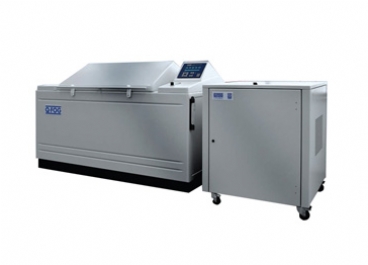
 鹽霧試驗箱
鹽霧試驗箱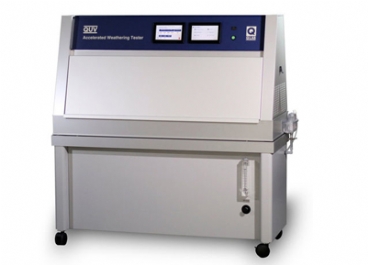
 粵公網安備 44060402000067號